The Thomas Tresham Signet Ring
A Renaissance gold and rock crystal ring with the coat of arms of Thomas Tresham (died 8 March 1559), England, c. 1557.
32mm h x 35mm w.
Weight 56 grams.
The obverse of the bezel engraved with the arms of Tresham, per saltire sable and argent divided diagonally in chief three trefoils slipped (2-1 above, 1-2 below)(1)
The reverse of the bezel engraved:
+ANNVL[VS]*THO[MAS]*TRESAMI*MIL[ITES]*D[OMI]NI*S[AN]CTE*IOAN[NES] (Ring of Thomas Tresami, Knight, Master of St. John).
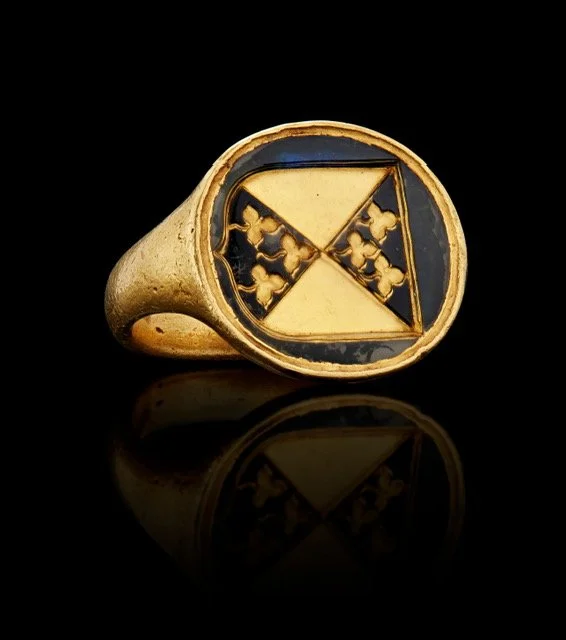
Sir Thomas Tresham’s signet ring is of striking size and importance and was undoubtedly meant to be seen as a symbol of his status. Its exaggerated size suggests worn over a gloved hand, likely the thumb, as was often Renaissance practice(2). Executed in rock crystal and mounted in 20 carat gold, consistent with the official English gold standard of the mid 16th century(3), the ring can be dated to circa 1557 and plausibly be associated with Tresham’s elevation to Grand Prior of the Order of the Knights Hospitallers of St. John of Jerusalem in England under Mary 1. And yet, despite the authority and status of its first owner, the Tresham family ultimately descended into financial ruin, the lineage becoming extinct in 1643(4).
Thomas Tresham (died 8 March 1559), emerges from the historical record as a remarkable man who navigated the instability of Tudor politics and his religous affiliations with notable success. A prominent Northamptonshire landowner and influential political figure, he belonged to one of England’s most fervently Catholic recusant families during the reigns of Henry VIII, Edward VI and Queen Mary, remaining resolutely loyal to Rome despite the Reformation(5). He proclaimed Mary’s accession in 1553 and accompanied her to London, briefly benefitting from the resurgence of Catholicism. On 13 November 1557 Mary appointed him Grand Prior of the restored Order of the Knights Hospitallers of St. John of Jerusalem in England(6), a prestigious position that granted him a seat in the House of Lords, and which this ring certainly intended to commemorate. The honour was short-lived, however, for he died in 1559, the same year Elizabeth’s first Parliament was dissolving Mary’s religious restorations.
Signet rings represented personal identity, lineage, role, status and authority, and in this case, devout faith. The formal blazon of the Treshams, together with the engraving on the reverse of the bezel, affiliated the owner with Catholic authority, but it might also be interpreted as a form of coded religious language through its Trinitarian symbolism, a visual and intellectual theme that was profoundly important to the Treshams. Their arms recur extensively throughout surviving 16th and early 17th century heraldic material, particularly at Triangular Lodge, a folly built at their family seat at Rushton, providing valuable insight into how the Treshams wished to be seen and understood within their religious adherence.
The ring is remarkable for several reasons, foremost among them its scale and weight. At 56 grams, it is one of the largest surviving Tudor rings and would have commanded considerable attention and authority when worn(7). In the Tudor period, rings were not confined, as they are today, to the four fingers and lower joints, but were worn on the thumb and upper joints, accounting for the occurrence of rings in exceptionally large sizes(8).
It’s survival in such excellent condition is remarkable. The rock crystal, engraved in intaglio to the reverse with armorial bearings, is undamaged, protecting the coloured foiling beneath, leaving the heraldic colours bright and clearly defined(9), despite the passage of nearly 470 years.
Recently discovered late sixteenth and early seventeenth century Tresham legal documentation in the British Library supports its authenticity and show the seal in use on official documents(10). Moreover, Thomas Fuller, a 17th century clergyman, historian and writer, records having personally seen such a ring, possibly the present one, in the possession of a Tresham descendant, noting, in particular, its extraordinary size(11):
“He was of an ancient family, and large estate….If the dimensions of his Body may be guessed by his finger, and the finger by his Ring (which (I) have seen in the possession of his Kinsman William Tresham Esq. of Newton in Northamptonshire) he was a little Giant and far greater than his portraiture on his Monument, almost demolished in Rushton-Church, in the same County. But Alexander’s soldiers were not in proportion so big as their shields left in India, and possible that Ring of State (serving for a Seale) was rather borne about him than on his finger.”
Lastly, the ring appears to correspond in shape and size with a ring depicted suspended from the neck of Tresham’s grandson, the recusant Sir Thomas Tresham (1543-1605), in an engraved portrait print, now in the British Museum(12). Not only does this reinforce its association across successive generations but it also shows another accepted manner in which such rings were worn(13).
At a time when confessional affiliation could determine the fate of a family, the significance of this ring stands well above ordinary armorial jewellery, witnessing the fluctuating fortunes of the Tresham family over two tumultuous centuries. Sir Thomas Tresham was comparatively lucky but subsequent generations faced increasing financial decline and political marginalisation and, in the case of Francis Tresham (1567-1605), imprisonment and posthumous beheading, following his implication in the Gunpowder Plot. Thus, its resurfacing offers not only a rare addition to the body of documented Tudor signet rings but also throws momentous light on the fragile alignment of loyalty, faith, and political service in a period of profound religious unrest.
Kirsten Everts is an unaffiliated researcher with a degree in Art History and professional experience at major auction houses and leading art advisors. She has worked for the past ten years as an independent dealer in fine and historic jewellery. This article examines a Renaissance ring.
REFERENCES:
(1) The Heraldry Society, Third Series Vol XII, Part 2, November 3, 2005:
Diagonally cut in black and white/silver, divided diagonally into four triangular sections; in the upper part three trefoils with stem, two side by side, one beneath them, and the same number again in the lower portion of the shield, one above and two below.
(2) https://www.lesenluminures.com/learn/44/
(3) Dr Christopher W Cori, Jewellery Alloys – Past, Present and Future, (COReGOLD Technology, Reading: Berks., UK), p 3-5.
(4) M. E. Finchs: The Wealth of Five Northamptonshire Families, 1540-1640, Oxford, 1956, p.66.
(5) Quoted in Memorials of Old Hamptonshire, ed. Alice Dryden, London, 1903, p. 129:
“According to Fuller [he]was a person of great command” in the county, a notable Catholic at a period when it began to be doubtful whether it were safer to be a Protestant or Catholic. But for him, at any rate, being a Catholic tended to his good; he had done" knight service" in proclaiming Queen Mary against Queen Jane and received from her the remarkable distinction of being made Prior of the re-erected Order of Knights Hospitallers of St. John of Jerusalem”.
(6) T. Fuller: The Church-History of Britain; from the birth of Jesus Christ until the year M.D.C.XLVIII (1648), (London, 1646), p. 606
(7) N. Awaits-Dean: Bejewelled: Men and Jewellery in Tudor and Jacobean England, The British Musuem, 2017, p.97.
(8) British Museum, A Guide to the Medieval Antiquities and Objects of Later Date in the Department of British and Medieval Antiquities, London, 1924, p. 148
(9) N. Awais-Dean : Bejewelled : Men and Jewellery in Tudor and Jacobean England, The British Museum, 2017, p.96
(10) The manuscript in the British Library which shows the best-kept Tresham seal impression was itself not dated, however, it is without doubt late sixteenth-early seventeenth century (British Library ADD MS 39829, ff 85, 206).
(11) T. Fuller: The Church-History of Britain; from the birth of Jesus Christ until the year M.D.C.XLVIII (1648), (London, 1646), p. 606.
(12) Remigius Hogenberg, engraving on paper, 147mm (trimmed), 1585, British Museum, O, 5.143
(13) https://www.lesenluminures.com/learn/44/